9.10.2025
Summary of the Study on Species Mobility
Prepared by Évolution Environnement inc. for Brigil (2023)
Champlain Urban Village Project and Its Developments
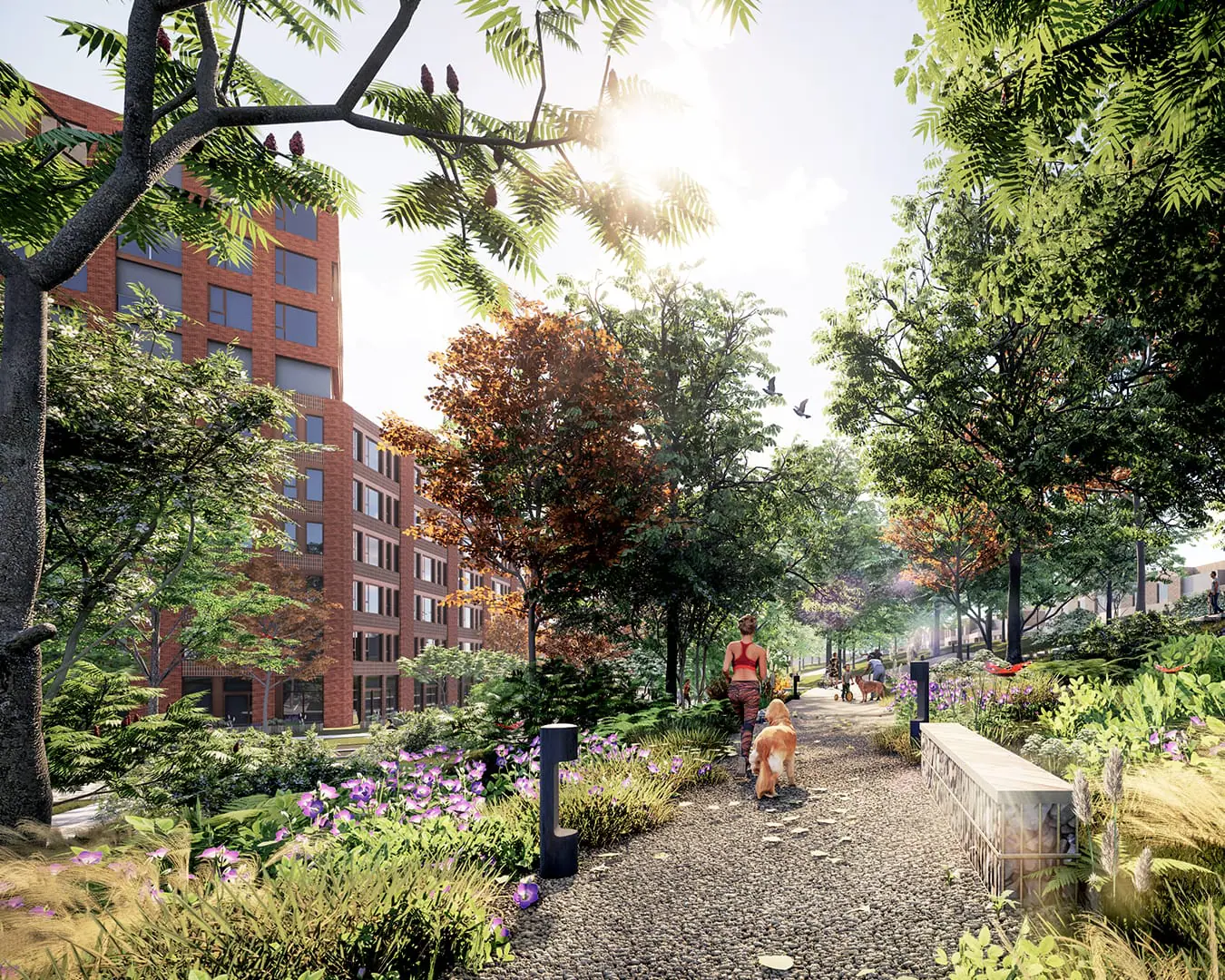
Creation of a complete, human-scale living environment that is respectful of the environment.
Potential for 6,000 residential units over nearly 34 hectares.
A vision that reconciles responsible development with respect for the environment.
A project recognized as an urban village core, providing access to local shops and services, including proximity to a future tramway station, among other amenities.
Keeping in Step with Ecosystems
Compliance with all applicable laws and regulations, particularly those related to environmental protection and urban planning.
Preservation of green space on 42% of the site, exceeding the City of Gatineau’s requirement of 14%.
Implementation of ecological corridors at least 50 metres wide.
These green developments go beyond the City of Gatineau’s regulations on green corridors and eco-territories.
The presence of several ecological corridors on the site is more effective for species mobility than a single very wide corridor.
Protection of Wetlands and Centuries-Old Trees
A Sector Undergoing Major Transformation
The Champlain Urban Village project area was historically agricultural until the 1980s–1990s.
The Champlain–Voyageur ecological corridor, identified in 2012, aimed to connect Gatineau Park to the Ottawa River for sensitive aquatic species.
This corridor was deemed non-functional as part of the present study due to topographical constraints and existing infrastructure in the surrounding area (wide roads, fenced sports fields, golf club).
It was not retained in the City of Gatineau’s Natural Areas Management Plan completed in 2013.
Solutions Put Forward by Brigil
Creation of a functional terrestrial corridor developed west of the site, with a minimum width of 50 metres and an average width of 80 metres, exceeding the minimum requirement of 30 metres for local wildlife.
Preservation of aquatic species mobility: since the site is terrestrial, aquatic species use the watercourse located west of the site, outside the project perimeter.
Full maintenance of ecological connectivity for all species present on the site, including both fauna and flora.
Key Findings of the Study
Species Mobility
The Champlain Urban Village project does not hinder species mobility.
Several smaller ecological corridors are incorporated into the project design, an approach that is more effective in facilitating the movement of local species, including large ungulates (deer, etc.).
The site is not connected to a watercourse; aquatic species instead use the watercourse located west of the project area, outside its perimeter.
The main barriers to wildlife mobility are external, such as high-traffic roads, fenced properties, and the lack of hydrological connectivity.
Fauna, Flora, and Wetlands
No protected plant or animal species were recorded on the site.
Protection of wetlands and centuries-old trees, with compensatory measures planned for an area affected by a former filled-in ditch.
Plant dispersal follows dynamics similar to those of animals and can occur over long distances via wind or wildlife.
Animal mobility indirectly contributes to plant dispersal, fostering ecological diversity.
Presence of common terrestrial species well adapted to urban and peri-urban environments, such as white-tailed deer and raccoons.
Conservation efforts are primarily directed toward more sensitive species whose habitats are more vulnerable to human disturbance.
Protection of wetlands and centuries-old trees, with compensatory measures planned for an area affected by a former filled-in ditch.
Study Conclusions and Recommendations
The Brigil Group project complies with environmental standards established by governmental authorities and does not impede species mobility thanks to the protection and conservation measures implemented.
Restoration efforts in the area should focus on Moore Creek and Des Fées Creek, particularly on institutional lands such as those belonging to UQO.
These interventions would be more beneficial for truly vulnerable aquatic species.
About the Study
The Évolution Environnement study was conducted in 2023 for the Brigil Group by Mr. Lionel Humbert, biologist (PhD).
Specializing in botany and wetland fauna, he also focuses on vegetation responses to environmental change and the use of wetlands as filtration zones.
A recognized biologist, he has participated in numerous major projects in transportation, ecological restoration, and decontamination.
Related News
Lorem ipsum dolor sit amet consectetur adipiscing elit. Praesent commodo nunc vitae justo fermentum, sed posuere sapien dignissim. Curabitur tempus, risus id viverra luctus, nunc elit blandit erat, sit amet finibus orci nisl non justo.
-3840x2400.webp)
4.20.2026
Ontario Expanding HST Rebate to Lower the Cost of New Homes in Partnership with the Federal Government
1.23.2026
Brigil Welcomes Curt Millar as Chief Financial Officer and Executive Vice President

11.5.2025
Since 1985, Brigil Has Been Making Home Ownership More Accessible and is Renewing its Mission

10.14.2025
A Community Manager: The Key to a More Connected and Engaging Experience in Luxury Rental Apartments